curated news excerpts & citations
…
Trump’s objectives for going to war sound vague because they are. The event that triggered his attack is also vague—so far, there is no evidence of an imminent threat that required the attack. His prescription for what his war is trying to accomplish is also vague.
It’s a given that this sort of vaguely justified attack on another country usually reflects that the leaders in the attacking country are worried about losing power and are launching a war to try to get disaffected people to rally around the flag.
(Heather Cox Richardson more…)
Flurries of threats, then attacks, then attacks on oversight and independent evidence
…
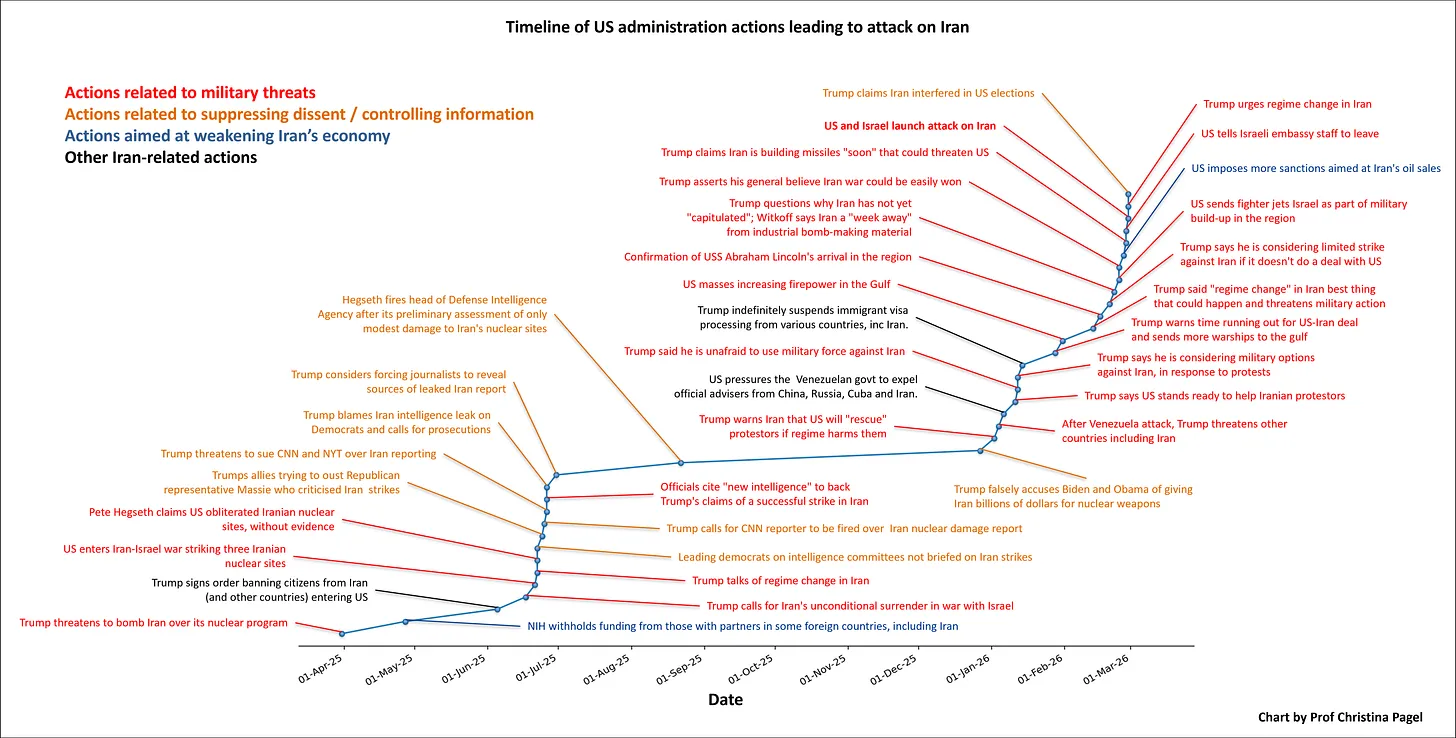
This has clearly not come out of nowhere. Trump first threatened to bomb Iran over its nuclear programme in March 2025 – just two months after his inauguration. Then there was a flurry of activity precipitated by Israel’s strikes on Iran last summer – Trump quickly joined in and claimed to have obliterated Irans’s nuclear capabilities.
There followed several months of relative quiet – most likely because the US spent the autumn ramping up its military presence and threats to Venezuela, culminating in its January attack on Venezuela. The day after the capture of Maduro, Trump threatened other countries – including Iran. This coincided with huge domestic protests in Iran. Trump actively enouraged these and promised to come to the protestors’ aid. Trump repeatedly threatened military strikes on Iran, but did not launch any in January, despite the Iranian regime killing thousands of protestors in its most brutal ever crackdown on dissent. This might have been because Trump is an unreliable supporter and doesn’t care about the Iranian people. It might also have been for the practical reason of needing time to move military firepower from Venuezelan waters to the Gulf region – which the US did steadily over January and February this year.
The US successfully forced Iran to the negotiating table over its nuclear program, but last week Trump and his officials started claiming that Iran was weeks away from a bomb (which is very unlikely to be true) and increasing its threatening rhetoric. The Israelis said today that their attacks today had been coordinated with the US and planned for months, so it seems likely that the negotiations were never in earnest from the US perspective.
(more…)