curated news excerpts & citations
… trying to ‘unbury the lede’

Jennifer Rubin:
There are no ‘red states.’
Texas elected Democrats for governor, lieutenant governor, attorney general, comptroller, agriculture commissioner, railroad commissioner, and land office commissioner. Democrats also flipped control of the state education board and the state House of Representatives. (And flipped 4 state supreme court seats.) Of course, a Democrat won the U.S. Senate seat. Was Texas a “red state” before the midterms, or was it simply one that — by default — voted Republican until MAGA misrule, corruption, and cruelty became too much to bear? The distinction is not insignificant.
Two weeks ago, Georgia elected Democrats for governor, lieutenant governor, attorney general, secretary of state, agriculture commissioner, labor commissioner, school superintendent, and insurance commissioner. Democrats flipped the state house and held the U.S. Senate seat. Was Georgia previously a “red state,” or a state ready to dump Republicans who had run the state into the ground?
It’s hard to think of North Carolina as a “red state” since Democrats easily flipped the U.S. Senate seat held by retiring Republican Thom Tillis, converted a 4-10 deficit to a likely 11-3 split in the U.S. House, won control of the state assembly by flipping 21 seats, and came just shy of flipping the state senate. With a Democratic governor, lieutenant governor, attorney general, secretary of state, and superintendent of public instruction, it seems to have shed its “red state” identity.
States invariably called “red” before the latest election — Kansas, Iowa, Ohio, and Alaska — will have a Democratic governor and one Democratic U.S. senator. Perhaps Democrats will stop writing them off as electorally unreachable, and Republicans can stop treating them as “safe” states that generally voted Republican for president in recent cycles.
“Red state” was always a misnomer, of course, since states don’t have a political affiliation.
There were always Democrats and Democratic-leaning independents in these states. Likewise, there have always been, for example, Republicans (not to mention a tradition of Republican governors who survived the blue tsunami) in New England states such as Vermont and New Hampshire, who have voted Democratic for president in recent cycles and sent Democrats (or independents affiliated with Democrats) to the U.S. Senate.
If we peek ahead to 2028 Senate races, are the contests in Kansas, Iowa, Alaska and North Carolina “red state” races or are they better understood as “more competitive races than previously believed in states that voted solidly Republican until Donald Trump wrecked the Republican Party”?
James Eagle:
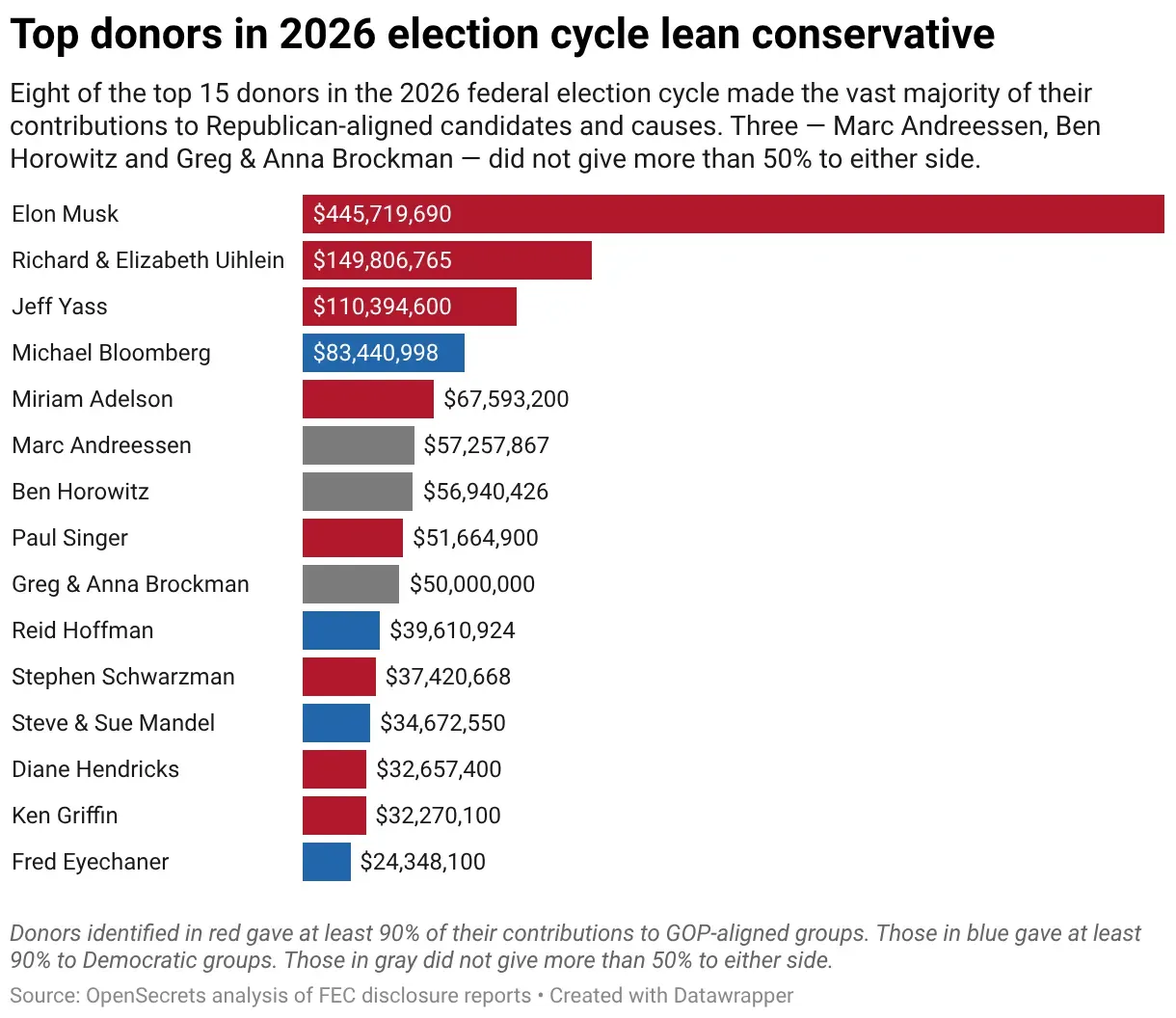
Elon Musk spends almost half a billion dollars on politics
-
Rook T. Winchester:
This is an unauthorized test of the National Emergency Alert SystemHad there been an actual emergency, we would have failed to notify you in a timely manner, or possibly at all. We don’t have as many people here on weekends, and the last employee who understood how this sh*t worked was fired for refusing to replace the emergency siren with Donald Trump screaming, “I ALONE CAN FIX IT!”
Please be advised that the United States is currently experiencing several dozen emergencies, none of which meet this administration’s definition of an emergency, which is something that truly inconveniences the President personally.
(Rook T. Winchester more…)Jessica Lyons @ Register:
Daily disruptive outages that ground planes and halt work – welcome to the new normalDean Blundell:
Apple Pay Just Died, Schwab Locked Out Investors, and The National Weather Service is Down
The NSA Went Dark This Morning – the Morning After JD Vance Told You Not to Worry But to “Be Prepared” For the Worst, While the FBI Announced That America is Under Cyber Attack.Heather Cox Richardson:
Letters from an American – November 17, 2026…
In the U.S. government, the crusade of the Department of Government Efficiency (DOGE) also led to job losses or resignations in IT: almost 20,000 of them in 2025 alone. As Natalie Alms of Government Executive reported last February, those losses affected a key public health tracking system, the modernization of IRS tax systems, and a USPS benefits program, and threatened the government’s cyber defense system.The Trump administration cut the workforce of the Cybersecurity and Infrastructure Security Agency (CISA) by about a third, including most of its senior career officials, and has proposed cutting another $700 million from its budget in 2027, saying it wants to cut “weaponization and waste.”
In the worldview of Trump and his allies, government workers are lazy and useless: in March 2025, Trump said of government workers: “[M]any of them don’t work at all. Many of them never showed up to work.” He claimed his administration was saving billions of dollars by getting rid of “fat and waste and fraud and abuse,” and that they’re “keeping the best people.”
But now, not even two years into Trump’s second administration, things are falling apart, and no one in the administration is capable of putting them back together.
(Heather Cox Richardson more…)
-
Heather Delaney Reese:
Trump abandons America for dictatorsRobert Reich:
America’s transportation, communications, and technological infrastructure may be breaking down, and no one in the Trump regime is taking responsibility for fixing it
-
Michael Thomas:
Data Center Construction Just Slowed for the First Time in More Than a YearWhether or not the slowdown will last is the trillion-dollar question

(Michael Thomas more…)

The January 6Memory Project
ICE Detention Expansion Tracker
A field guide to claims
Last Days in Two Nations
Climate.us
formerly Climate.gov
Climate Solutions Explorer
Have I Been Flocked?
Cleanview Data Center Traker
Brockovich AI Data Center Reporting
resources tracking the “Andes” hantavirus outbreak
Apocalypse Early Warning System
Al Jazeera Death toll and injuries live tracker
Mourning Those Who Have Died in ICE Custody
Mike Ludwig @ truthout: ICE Says 51 People Died in Custody Under Trump. Experts Say That’s an Undercount.
ICE Accountability Project
Sergio Martínez-Beltrán, Ximena Bustillo, Jasmine Garsd @ NPR: Deaths of migrants in ICE custody hit record high under Trump
- October 17: Emiliano Andrade-Covarrubias
- September 18: Carlos Josue Marchena Marchena
- August 31: Pierre Damas Bel
- August 1: Edwin Lopez-Cornejo
- July 19: Jose Chajon-Raxon
- July 14: Juan Jairo Coronilla Duran
- July 13: Joan Sebastian Guerrero
- July 7: Lorenzo Salgado Araujo
- June 4: Mamuka Artmeladze
- April 16: Aled Damien Carbonell-Betancourt
- March 25: Jose Guadalupe Ramos-Solano
- March 16: Royer Perez-Jimenez
- March 14: Naseer Paktiawil
- February 25: Nurul Amin Shah Alam
April 1 – Jennifer Peltz and Jake Offenhartz @ AP: Death of a refugee left at a Buffalo doughnut shop by Border Patrol is ruled a homicide - January 24: Alex Pretti
- January 14: Heber Sanchaz Dominguez
- January 14: Victor Manuel Diaz
- January 9: Parady La
- January 7: Renée Good
- January 6: Luis Beltran Yanez-Cruz
- January 5: Luis Gustavo Nunez Caceres
- January 3: Geraldo Lunas Campos
- December 31, 2025: Keith Porter
Suffering Under President Obama
NACDL Criminal Case Tracker
Texas Tribune: A Walk for Peace: photos of Fort Worth monks’ journey to Washington
Walk for Peace – Dhammacetiya – The Ancient Sacred Buddhist Scripture Stupas
Margaret Chase Smith: Declaration of Conscience
NPR: January 6, 2021: A visual archive
Accountability Initiative ICE List
GriftMatrix
Trump Action Tracker
Timeline: Tracking the Trump Justice Department’s Anti-Voting Shift
Tracking the Lawsuits Against Trump’s Agenda
Trump Pardons Database
Project 2025 Tracker
DOGE Tracker
ProPublica: Elon Musk’s Demolition Crew
Wired: 6 Tools for Tracking the Trump Administration’s Attacks on Civil Liberties

Leave a Reply